
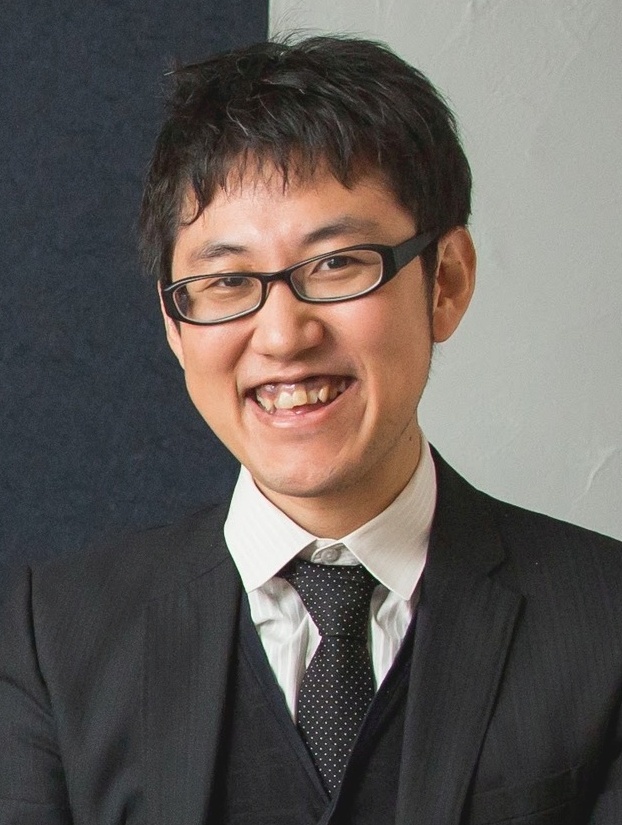
Yuu Nakajima
Ph.D. (Informatics), Associate Professor
Biography
Job History
- Associate Professor (2018/04 - ), Department of Information Science, Faculty of Science, Toho University
- Lecturer (2013/04 - 2018/03), Department of Information Science, Faculty of Science, Toho University
- Researcher and Assistant Professor (2009/04 - 2013/03), Graduate School of Informatics, Kyoto University
Educational History
- Ph.D. Course Student (2006/04 - 2009/03), Department of Social
Informatics, Graduate School of Informatics, Kyoto University.
Ph.D Thesis: Outdoor Evacuation Experiment Augmented by Massively Multiagent Simulation.
Supervisor: Professor Toru Ishida. - Master Course Student (2004/04 - 2006/03), Department of Social Informatics, Graduate School of Informatics, Kyoto University.
- Bachelor of Engineering (2000/04 - 2004/03), Division of Systems Science, School of Engineering Science, Osaka University.
Research
Research Topics
- Multiagent Simulation
- Gaming Simulation
- Participatory Design
- Large-scale Multiagent System
- Deep Learning for Medical Diagnosis
Modeling Individual Driving Behavior for Multiagent Simulation
In order to model diverse traffic situations, such as vehicular traffic with significant numbers of senior drivers, it is essential to model the individuality of drivers; almost all previous works on multiagent simulation assumed the uniform driver model. In order to accomplish the key issue, I propose a novel methodology that can model each driver’s individual behaviour. The proposed approach uses a 3D virtual driving simulator to collect realistic driving log data from human subjects. We extract driving rules from the log data by interviewing each subject. We then construct unique driving models, which can explain each driver’s behaviour, by the application of hypothetical reasoning. In our research, we show that our proposed method can generate driving models which represent different types of driving styles.
Evacuation Navigation System based on Massively Multi-agent Systems
In a guidance system which uses ubiquitous information infrastructure on a city, the system can acquire information of each individual user in real time. However, quantity of the information becomes enormous. There occurs a problem that a human who control system cannot handle all the information. Our approach is that a human gives rough navigation to agents and the agents give precise navigation to each person. We aim at realizing a mega scale navigation system using GPS-capable cellular phones.
A system which provides personalized navigation on city space can be developed based on a massively multi-agent system. In our research, an evacuation system, which uses multi-agent simulation and assumes a disaster in city, was implemented. Using this system, an evacuation experiment was conducted using real world human subjects and virtual space simulation agents. The system informed human evacuees of situation of the simulation by sending evacuation information to GPS mobile phones. As a result, the system succeeded in letting subjects feel the existence of crowds. Moreover, the scalability of the system was also confirmed in a performance evaluation.
Medical Artificial Intelligence and Image Analysis
We are conducting research on the application of artificial intelligence and image processing technologies to the medical field. In particular, our research focuses on deep learning for extracting features useful for diagnosis and treatment from medical images, transfer learning and model learning for developing effective models from limited clinical data, and techniques for separating medically relevant information from patient-specific information contained in medical images. Through these studies, we aim to advance diagnostic and treatment support using medical images and to establish fundamental technologies for the safe and effective use of medical data.
Publication
Journals
Please, read Copyright Policy before downloading following pdf files.
- Temporal Stability and Instructional Adaptability of a Web-based Gaming Simulation for Active Learning in Management Education. Journal of Information Processing, Vol.12, No.3, 2026. (to appear)
- Semantic Segmentation of Small-Scale Urban Green Spaces Using LiDAR and Deep Learning. Urban and Regional Planning Review, Vol.13, No.0, pp. 215-232, 2026.
- Massive Multiagent-based Urban Traffic Simulation with Fine-Grained Behavior Models, Journal of Advanced Computational Intelligence and Intelligent Informatics (JACIII), Vol.15 No.2, Fuji Technology Press, pp. 233-239, Mar. 1, 2011.
- Learning from Humans: Agent Modeling with Individual Human Behaviors, IEEE Transactions on Systems, Man, and Cybernetics Part A:Systems and Humans., 41(1) pp. 1-9, Jan. 1, 2011.
Peer-Reviewed Conference and Workshop Papers
Please, read Copyright Policy before downloading following pdf files.
-
Ryuunosuke Kounosu, Wonjik Kim, Atsushi Ikeda, Hirokazu Nosato,
Yuu Nakajima.
Artificial intelligence in cystoscopic bladder cancer classification
based on transfer learning with a pre-trained convolutional neural
network without natural images
,
Proc. SPIE 12927, Medical Imaging 2024: Computer-Aided Diagnosis
,
1292727, 10 pp., 3 Apr. 2024.
[DOI]
-
Yuya Ieiri, Yuu Nakajima, Reiko Hishiyama.
Walk Rally Application Development Environment Suitable for Individual Situations.
Proceedings of the 10th International Conference on E-Education, E-Business, E-Management and E-Learning (IC4E 2019),
ACM, pp. 438-442, Tokyo, Japan, Jan. 10-13, 2019.
[DOI]
-
Yuya Ieiri, Reiko Hishiyama, Yuu Nakajima.
Walk Rally Application for Revitalizing Shopping Areas.
Proceedings of the 9th International Symposium on Information and Communication Technology (SoICT 2018),
ACM, pp. 344-350, Da Nang, Vietnam, Dec. 6-7, 2018.
[DOI]
- Yuya Ieiri, Yuu Nakajima, Reiko Hishiyama. Attempt to Mitigate Congestion by Providing Latent Information with Walk-Rally Application. Proceedings of the 9th International Conference on E-Education, E-Business, E-Management and E-Learning (IC4E 2018), ACM, pp. 80-84, San Diego, USA, Jan. 11-13, 2018.
- Yuya Ieiri, Takuya Mizukami, Yuu Nakajima, Ryota Ayaki, Reiko Hishiyama. Effect of First Impressions in Tourism by Using Walk Rally Application. Culture and Computing 2017, IEEE Computer Society, pp. 1-6, Japan, Sep. 10-12, 2017.
- Ryutaro Otsuka, Yuu Nakajima, Reiko Hishiyama. Experimental Analysis for the Design of Sustainable Service Computing Infrastructure. Culture and Computing 2017, IEEE, pp. 29-34, Japan, Sep. 10-12, 2017.
- Yuu Nakajima, Kana Tajima, Yoshiyuki Kitajima, Reiko Hishiyama. Study of a Multilingual Translation Process Using Statement Restriction Rules. The 5th International Conference on Applied Computing and Information Technology (ACIT 2017), IEEE, pp. 81-85, Japan, Jul. 9-13, 2017.
- Yuya Ieiri, Yuu Nakajima, Ryota Ayaki, Reiko Hishiyama. A Walk Rally Application to Motivate Users to Visit Potential Sightseeing Resources. 2017 IEEE 41st Annual Computer Software and Applications Conference (COMPSAC), IEEE Computer Society, Vol. 2, pp. 637-642, Jul. 4-8, 2017.
- Toru Ishida, Donghui Lin, Masayuki Otani, Shigeo Matsubara,
Yohei Murakami, Reiko Hishiyama, Yuu Nakajima, Toshiyuki Takasaki,
and Yumiko Mori. Field-Oriented Service Design: A Multiagent Approach. Takashi
Maeno, et.al.(Eds.), Serviceology for Designing the Future (Selected and Edited Papers of
the 2nd International Conference on Serviceology), Springer, pp. 451-463, Sep. 19, 2016.
[DOI]
- Yuu Nakajima, Reiko Hishiyama, Takao Nakaguchi. Multiagent gaming system for multilingual communication. 2015 International Conference on Culture and Computing, IEEE, pp. 215-216, Oct. 17-19, 2015. (demo paper)
- Reiko Hishiyama, Yuu Nakajima. Business game-based experimental active learning using a multiagent approach for management education. The 3rd International Conference on Applied Computing and Information Technology and 2nd International Conference on Computational Science and Intelligence (ACIT-CSI 2015), IEEE, pp. 254-259, Okayama, Jul. 12-16, 2015.
- Evaluation of Rewriting Service in Language Translation Web Services Workflow. Culture and Computing 2013, IEEE Computer Society, pp. 21-26, Kyoto, Sep. 16-18, 2013.
- Case Study on Analyzing Multi-Language Knowledge Communication. Proceedings of 2012 International Conference on Culture and Computing (Culture and Computing 2012), pp. 35-42, Hangzhou, Oct. 24, 2012.
- A Simulator Integration Platform for City Simulations. The 14th International Conference on Principles of Practice in Multi-Agent Systems (PRIMA-2011), Lecture Notes in Computer Science, Springer, LNCS 7047, pp. 484-495, 2011.
- Multi-model based Simulation Platform for Urban Traffic Simulation. The 13th International Conference on Principles of Practice in Multi-Agent Systems (PRIMA-2010), Lecture Notes in Computer Science, Springer, LNCS 7057, pp. 228-241, 2012.
- Wide-Area Traffic Simulation Based on Driving Behavior Model. The 12th International Conference on Principles of Practice in Multi-Agent Systems (PRIMA-2009), Lecture Notes in Computer Science, Springer, LNCS 5925, pp. 459-470, 2010.
- Learning from Human Behavior in Participatory Simulation. Ambient Intelligence Perspectives II (Selected Papers from the 2nd International Ambient Intelligence Forum 2009), IOS Press, Vol. 5, pp. 147-157, 2010.
- Modeling Individual Driving Behaviors for Multiagent Traffic Simulation, The 6th Workshop on Agents in Traffic and Transportation (ATT-2010), pp. 5-12, Toronto, Canada, May 11, 2010.
- Agent Modeling with Individual Human Behaviors. The 8th International Conference on Autonomous Agents and Multiagent Systems (AAMAS-2009), IFAAMAS, pp. 1369-1370, Budapest, Hungary, May 10-15, 2009. (Short Paper)
- Evacuation Guide System based on Massively Multiagent System. The 7th International Conference on Autonomous Agents and Multi-agent Systems (AAMAS-2008), IFAAMAS, Estoril, Portugal, May 12-16, pp.1653-1654, 2008. (Demo Paper)
- Analysis of Pedestrian Navigation using Cellular Phones. The 10th Pacific Rim International Conference on Multi-Agents (PRIMA-2007), Lecture Notes in Artificial Intelligence, Springer, LNAI 5044, pp. 288-297, May 28, 2009.
- A Driver Modeling Methodology Using Hypothetical Reasoning for Multiagent Traffic Simulation. The 10th Pacific Rim International Conference on Multi-Agents (PRIMA-2007), Lecture Notes in Artificial Intelligence, Springer, LNAI 5044, pp. 278-287, May 28, 2009.
- Augmented experiment: Participatory design empowered by multiagent
simulation. The 20th International Joint Conference on
Artificial Intelligence (IJCAI-2007), pp.1341-1346, Hyderabad, India, Jan. 6-12, 2007. (212/1353=16%) [PDF (©IJCAI)] [bibtex]
- Disaster Evacuation Guide Using a Massively Multiagent Server and GPS Mobile Phones. The 7th International Symposium on Appications and the Internet (SAINT-2007), IEEE Computer Society, Hiroshima, JAPAN, Jan. 15-19, 2007. (18/64=28%)
- Caribbean/Q: A Massively Multi-Agent Platform with Scenario Description Language. The 2nd International Conference on Semantics, Knowledge and Grid (SKG-2006), IEEE Computer Society, Guilin, China, Nov.1-3, 2006. (18%)
- Protocol Description and Platform in Massively Multiagent Simulation. The 1st International Workshop on Agent Technology for Disaster Management (ATDM-2006), pp. 135-142, Hakodate, Japan, May 8, 2006.
Conference Presentations and Abstracts
-
Yosuke Omizu, Yuki Shibata, Yuu Nakajima, Misuzu Kakizaki.
4-Stream Mid-Level Fusion with nDSM Confidence Gating for Urban Green Space Extraction from RGB and LiDAR derived images.
International Symposium on Remote Sensing (ISRS2026),
Matsue, Japan, May 2026. (Oral, Non-peer-reviewed)
-
Chie Takiguchi, Noriko Matsui, Shoko Inoue, Daisuke Kudo,
Yuu Nakajima, Tomoko Inoue.
Ideal Design of an Information Sharing System to Promote Recovery of Post Intensive Care Patients: A Qualitative Descriptive Study.
International Council of Nurses Congress 2025,
Helsinki, Finland, Jun. 13, 2025. (Poster)
-
Yosuke Omizu, Yuki Shibata, Yuu Nakajima.
Impact assessment of small-scale urban green by RGB-D Machine Learning.
The 44th Annual Conference of the International Association for Impact Assessment (IAIA25),
May 2025. (Poster, Non-peer-reviewed)
-
Katsuto Iwai, Hirokazu Nosato, Yuu Nakajima.
Medical Image Diagnosis Support System with Image Anonymization Based on Deep Learning Techniques.
The 7th International Conference on Intelligent Medicine and Image Processing (IMIP 2025),
Kyoto, Japan, Mar. 28-31, 2025. (Poster, Peer-reviewed)
-
Wonjik Kim, Atsushi Ikeda, Yuu Nakajima, Hirokazu Nosato.
Pre-Trained Vision Transformer with Mixed Formula-Driven Supervised Learning for Cystoscopy Diagnosis.
The 46th Annual International Conference of the IEEE Engineering in Medicine and Biology Society (EMBC 2024),
Jul. 15-19, 2024. (Poster, Peer-reviewed)
-
Atsushi Ikeda, Ryuunosuke Kounosu, Wonjik Kim, Hirokazu Nosato,
Yuu Nakajima, Hiroyuki Nishiyama.
PD27-08 Pre-training an AI Model Using Two Types of Automatically Generated Images for Cystoscopy AI Diagnosis of Bladder Cancer.
Journal of Urology,
vol. 211, no. 5S, May 2024, e553.
[DOI]
(Conference Abstract, AUA Annual Meeting 2024)
Chapter of Book
-
Chapter 12: Gaming for Language Services. Yohei Murakami, Donghui Lin, Toru Ishida (eds.), Services Computing for Language Resources. Cognitive Technologies.
Springer,
pp. 193-208, Feb. 24, 2018. [bibtex] [DOI]
- Chapter 6: Multi-Agent Simulation. Toru
Ishida (eds.), Field Informatics, Cognitive Technologies Series, Springer-Verlag,
pp. 89-105, Jun. 19, 2012. [bibtex] [DOI]
Seminar Talks
- Yuu Nakajima, Massive Multiagent-based Urban
Traffic Simulation with Fine-Grained Behavior Models. Technical University Berlin,
Germany, Feb. 22 and Feb. 29, 2010.
Newspaper Reports
- GPS-guided evacuation system tested by Kyoto Univ., Daily Yomiuri, Jan. 14,
2006.
Ph.D. Thesis
- Outdoor Evacuation Experiment Augmented by Massively Multiagent Simulation,
Kyoto University, 2009. [NDL]
Awards
- Yuya Ieiri, Yuu Nakajima, Reiko Hishiyama. Attempt to mitigate
congestion by providing latent information with walk-rally application. Best oral presentation award,
9th International Conference on E-Education, E-Business, E-Management
and E-Learning (IC4E 2018), January 11-13, San Diego, 2018.
- Yuya Ieiri, Takuya Mizukami, Yuu Nakajima, Ryota Ayaki and Reiko Hishiyama. Effect
of First Impressions in Tourism by Using Walk Rally Application. Best Paper Candidates,
Culture and Computing 2017, Japan, Sep. 12, 2017
- Yosuke Omizu, Yuki Shibata, Yuu Nakajima, Misuzu Kakizaki. 4-Stream Mid-Level Fusion with nDSM Confidence Gating for Urban Green Space Extraction from RGB and LiDAR derived images. International Symposium on Remote Sensing (ISRS2026), Matsue, Japan, May 2026. (Oral, Non-peer-reviewed)
- Chie Takiguchi, Noriko Matsui, Shoko Inoue, Daisuke Kudo, Yuu Nakajima, Tomoko Inoue. Ideal Design of an Information Sharing System to Promote Recovery of Post Intensive Care Patients: A Qualitative Descriptive Study. International Council of Nurses Congress 2025, Helsinki, Finland, Jun. 13, 2025. (Poster)
- Yosuke Omizu, Yuki Shibata, Yuu Nakajima. Impact assessment of small-scale urban green by RGB-D Machine Learning. The 44th Annual Conference of the International Association for Impact Assessment (IAIA25), May 2025. (Poster, Non-peer-reviewed)
- Katsuto Iwai, Hirokazu Nosato, Yuu Nakajima. Medical Image Diagnosis Support System with Image Anonymization Based on Deep Learning Techniques. The 7th International Conference on Intelligent Medicine and Image Processing (IMIP 2025), Kyoto, Japan, Mar. 28-31, 2025. (Poster, Peer-reviewed)
- Wonjik Kim, Atsushi Ikeda, Yuu Nakajima, Hirokazu Nosato. Pre-Trained Vision Transformer with Mixed Formula-Driven Supervised Learning for Cystoscopy Diagnosis. The 46th Annual International Conference of the IEEE Engineering in Medicine and Biology Society (EMBC 2024), Jul. 15-19, 2024. (Poster, Peer-reviewed)
- Atsushi Ikeda, Ryuunosuke Kounosu, Wonjik Kim, Hirokazu Nosato, Yuu Nakajima, Hiroyuki Nishiyama. PD27-08 Pre-training an AI Model Using Two Types of Automatically Generated Images for Cystoscopy AI Diagnosis of Bladder Cancer. Journal of Urology, vol. 211, no. 5S, May 2024, e553. [DOI] (Conference Abstract, AUA Annual Meeting 2024)
- Chapter 12: Gaming for Language Services. Yohei Murakami, Donghui Lin, Toru Ishida (eds.), Services Computing for Language Resources. Cognitive Technologies. Springer, pp. 193-208, Feb. 24, 2018. [bibtex] [DOI]
- Chapter 6: Multi-Agent Simulation. Toru Ishida (eds.), Field Informatics, Cognitive Technologies Series, Springer-Verlag, pp. 89-105, Jun. 19, 2012. [bibtex] [DOI]
Seminar Talks
- Yuu Nakajima, Massive Multiagent-based Urban
Traffic Simulation with Fine-Grained Behavior Models. Technical University Berlin,
Germany, Feb. 22 and Feb. 29, 2010.
Newspaper Reports
- GPS-guided evacuation system tested by Kyoto Univ., Daily Yomiuri, Jan. 14,
2006.
Ph.D. Thesis
- Outdoor Evacuation Experiment Augmented by Massively Multiagent Simulation,
Kyoto University, 2009. [NDL]
Awards
- Yuya Ieiri, Yuu Nakajima, Reiko Hishiyama. Attempt to mitigate
congestion by providing latent information with walk-rally application. Best oral presentation award,
9th International Conference on E-Education, E-Business, E-Management
and E-Learning (IC4E 2018), January 11-13, San Diego, 2018.
- Yuya Ieiri, Takuya Mizukami, Yuu Nakajima, Ryota Ayaki and Reiko Hishiyama. Effect
of First Impressions in Tourism by Using Walk Rally Application. Best Paper Candidates,
Culture and Computing 2017, Japan, Sep. 12, 2017
- GPS-guided evacuation system tested by Kyoto Univ., Daily Yomiuri, Jan. 14, 2006.
Ph.D. Thesis
- Outdoor Evacuation Experiment Augmented by Massively Multiagent Simulation,
Kyoto University, 2009. [NDL]
Awards
- Yuya Ieiri, Yuu Nakajima, Reiko Hishiyama. Attempt to mitigate
congestion by providing latent information with walk-rally application. Best oral presentation award,
9th International Conference on E-Education, E-Business, E-Management
and E-Learning (IC4E 2018), January 11-13, San Diego, 2018.
- Yuya Ieiri, Takuya Mizukami, Yuu Nakajima, Ryota Ayaki and Reiko Hishiyama. Effect
of First Impressions in Tourism by Using Walk Rally Application. Best Paper Candidates,
Culture and Computing 2017, Japan, Sep. 12, 2017
- Yuya Ieiri, Yuu Nakajima, Reiko Hishiyama. Attempt to mitigate congestion by providing latent information with walk-rally application. Best oral presentation award, 9th International Conference on E-Education, E-Business, E-Management and E-Learning (IC4E 2018), January 11-13, San Diego, 2018.
- Yuya Ieiri, Takuya Mizukami, Yuu Nakajima, Ryota Ayaki and Reiko Hishiyama. Effect of First Impressions in Tourism by Using Walk Rally Application. Best Paper Candidates, Culture and Computing 2017, Japan, Sep. 12, 2017
Professional Activities
- International Conference on Autonomous Agents and Multiagent Systems, Program committee, (AAMAS 2019)
- International Conference on Principles and Practice of Multi-Agent Systems, Web chair, (PRIMA 2018)
- International Conference on Agents, Program committee, (ICA 2016-2018)
- International Conference on Principles of Practice in Multi-Agent Systems (PRIMA), Program committee, (PRIMA 2012-2015, 2017-2018)
- International Joint Workshop of Data Oriented Constructive Mining and Multi-Agent Simulation (DOCMAS), Program committee(DOCMAC 2012-2014)
- Workshop on Agents in Traffic and Transportation (ATT), Program committee (ATT 2012, 2014, 2016, 2018)
- Pacific Rim workshop on Agent-based modeling and simulation of Complex Systems (PRACSYS), Program committee(PRACSYS 2010)
- Agent Based Simulation for a Sustainable Society (ABSSS), Program committee, (ABSSS 2011)
- International Student Workshop on Agents 2006 (ISWA), Student Committee(ISWA 2006)